Thirteen years of practice.
Storyboards, a Storyline build, and the Pragmatic product portfolio — thirteen years of senior instructional design practice. Full case write-ups available on request; most recent work is under NDA.
Content Portfolio
The senior instructional design work behind the exec-level results above — the templates, storyboards, and five productized courses I built and shipped at Pragmatic Institute.
Fire Extinguisher — PASS Method
Storyboard and built module for a fire-extinguisher safety training built around the four-step PASS method (Pull, Aim, Squeeze, Sweep). Each step gets purpose, critical content, visual direction, and interaction/animation specs with audio narration cues.
- Layered interaction — one layer per PASS step, with marker-driven hotspots.
- Visual direction for each step's illustration and animation.
- Audio cues for the Squeeze and Sweep layers (extinguisher use).
- Companion Articulate Storyline source ships with four named layers.
1.8 MB Storyline source with four layers (Pull the Pin, Aim the Nozzle, Squeeze the Trigger, Sweep the Extinguisher Side to Side), markers, animations, and audio cues. Open in Storyline 360 to inspect.




Pragmatic Institute — Product portfolio
Five productized courses built or substantially reworked during my tenure as Sr. Director and then VP of Product. I owned the content and creative function end to end — syllabus, instructor materials, participant workbooks, assessments, and facilitator tooling.
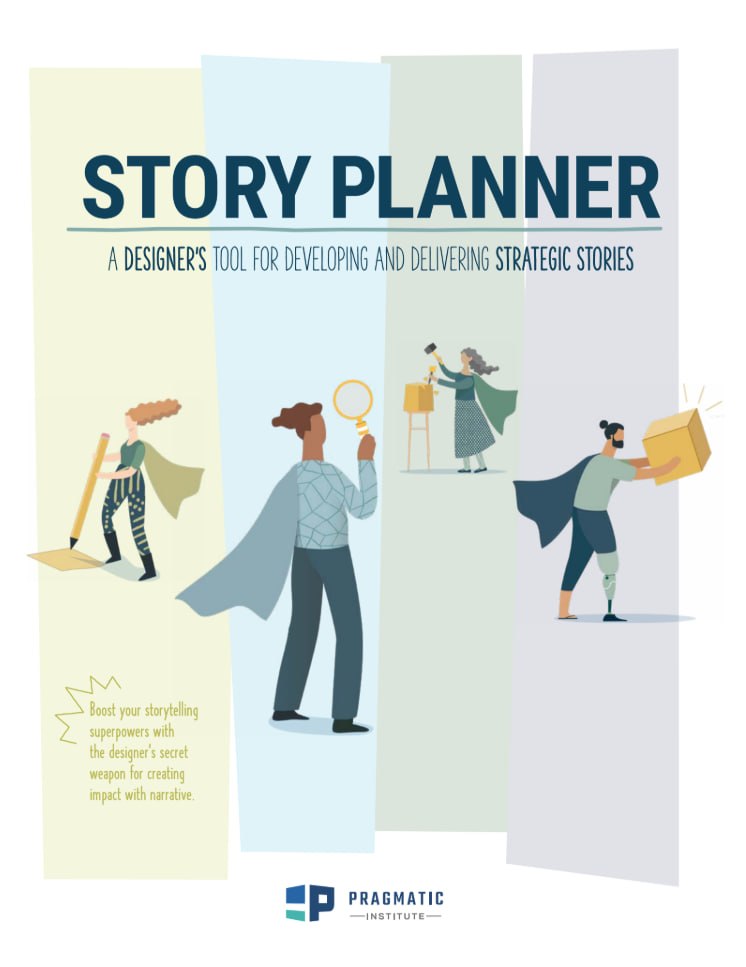
Design that changes behavior, not just minds
The context
Designers at Pragmatic were technically excellent but couldn't move stakeholders. They had frameworks for analysis but none for influence. Completion rates were high, but behavior change at the workplace wasn't — the typical L&D trap of "they learned it, but they didn't do it."
The work
I designed the Story Planner around four stages that mirror how memory and behavior actually work: Specify (what change you want, and for whom), Seek (what the audience already believes and feels), Shape (structure the story to land), and Share (deliver it like a prototype — test before the high-stakes moment).
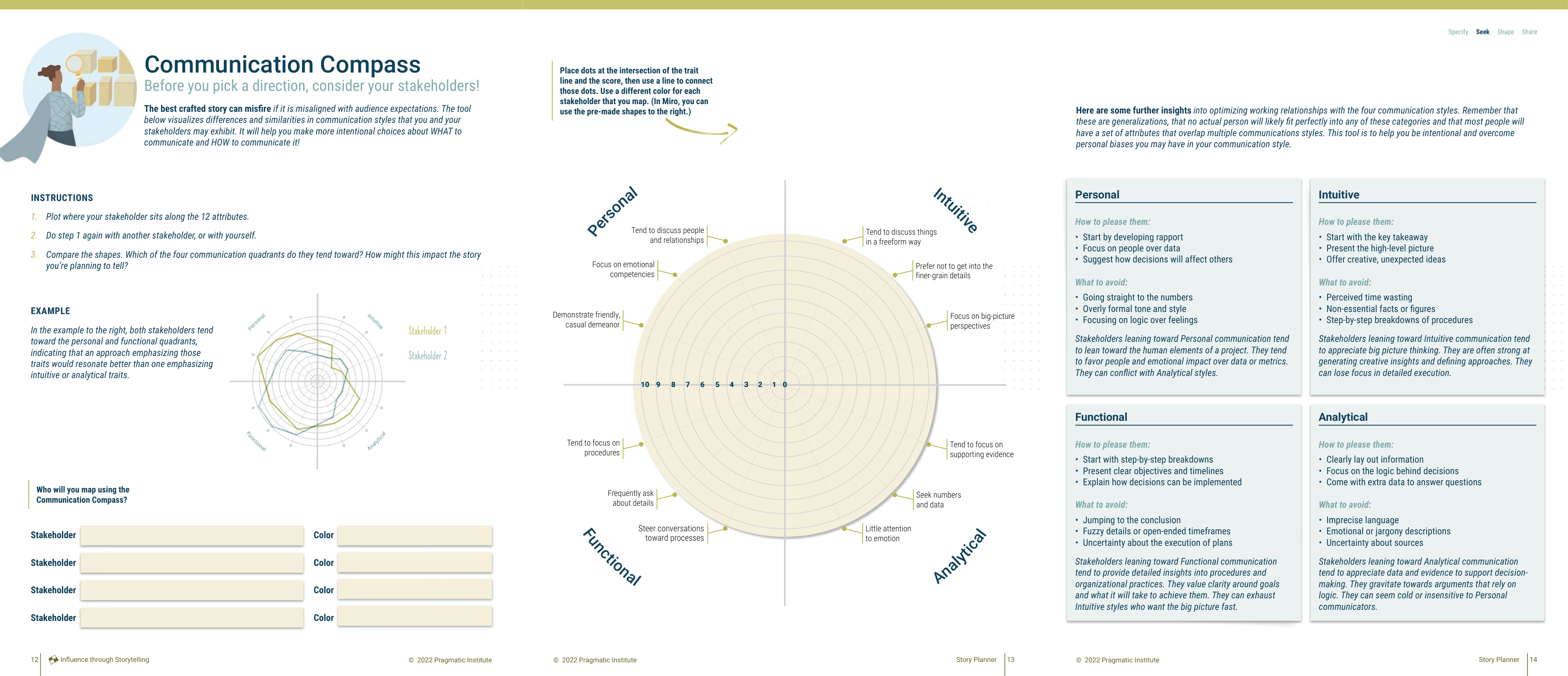
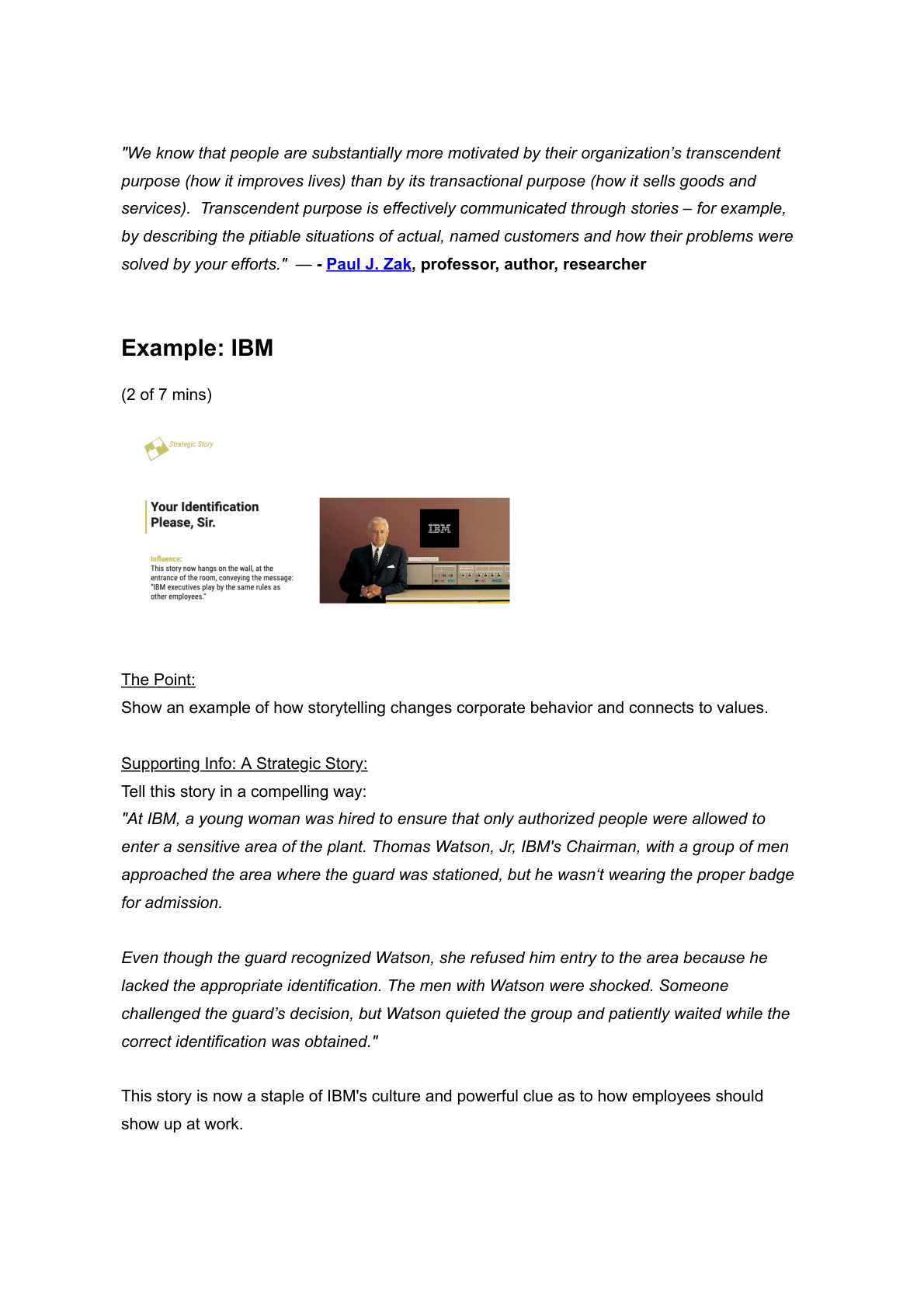
I paired the framework with a Communication Compass — a stakeholder-mapping tool that taught designers to adapt the same story for a Personal, Intuitive, Functional, or Analytical listener. Then I built instructor notes that treated the moderator like a learning designer: every module had explicit timing, a "the point is…" framing line, and a worked example so facilitation didn't drift.
What changed
The course became Pragmatic's flagship designer course, with 55 pages of instructor playbook and an 18-page participant workbook that participants kept and reused. The framework was the design language Pragmatic taught for the next two years.
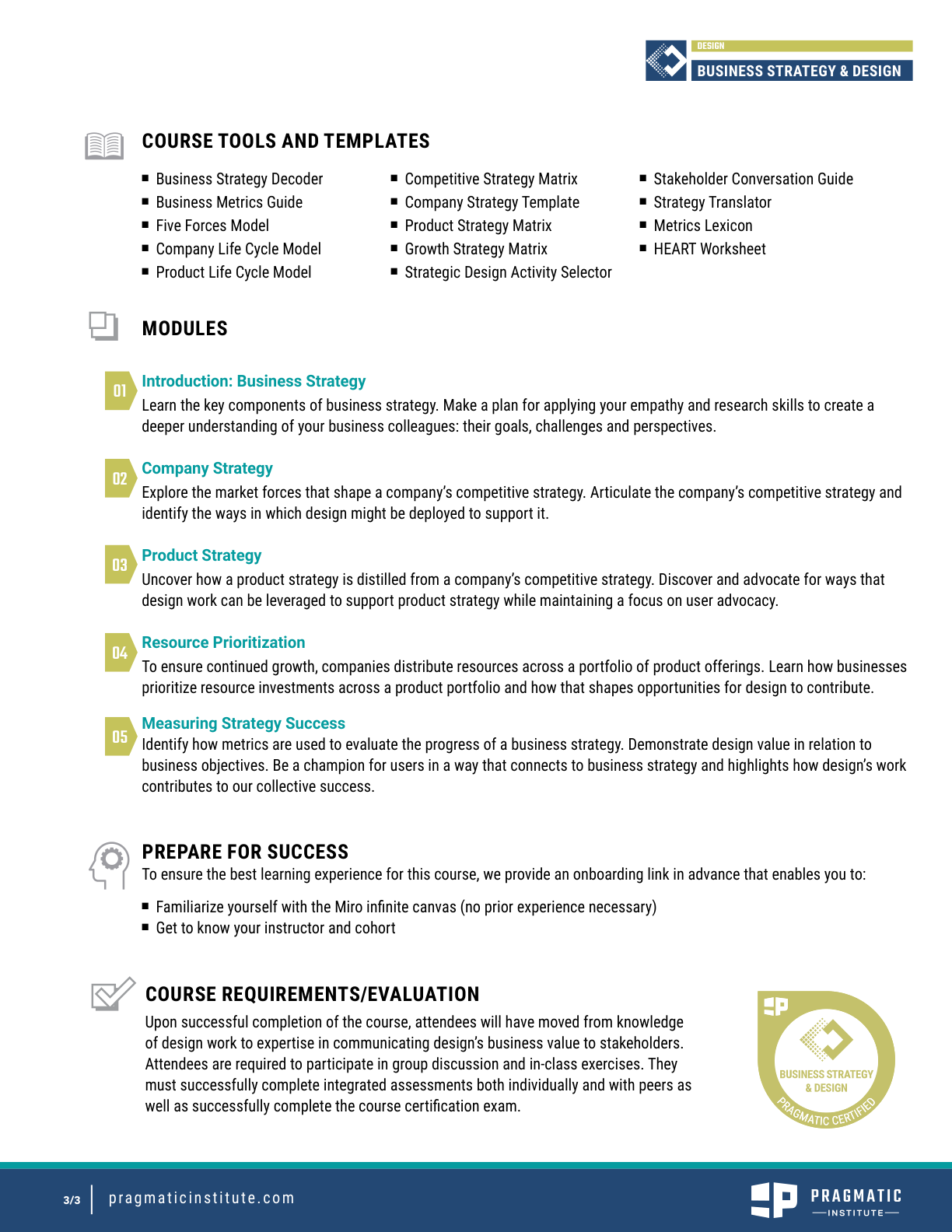
Learning objectives that survive a CFO review
The context
Designers at Pragmatic could explain their craft beautifully, but couldn't connect it to a CFO's question: "What's the ROI?" Their learning objectives read like "understand" and "appreciate" — verbs that don't translate to business metrics. I watched otherwise-strong designers lose budget conversations because their objectives were immeasurable.
The work
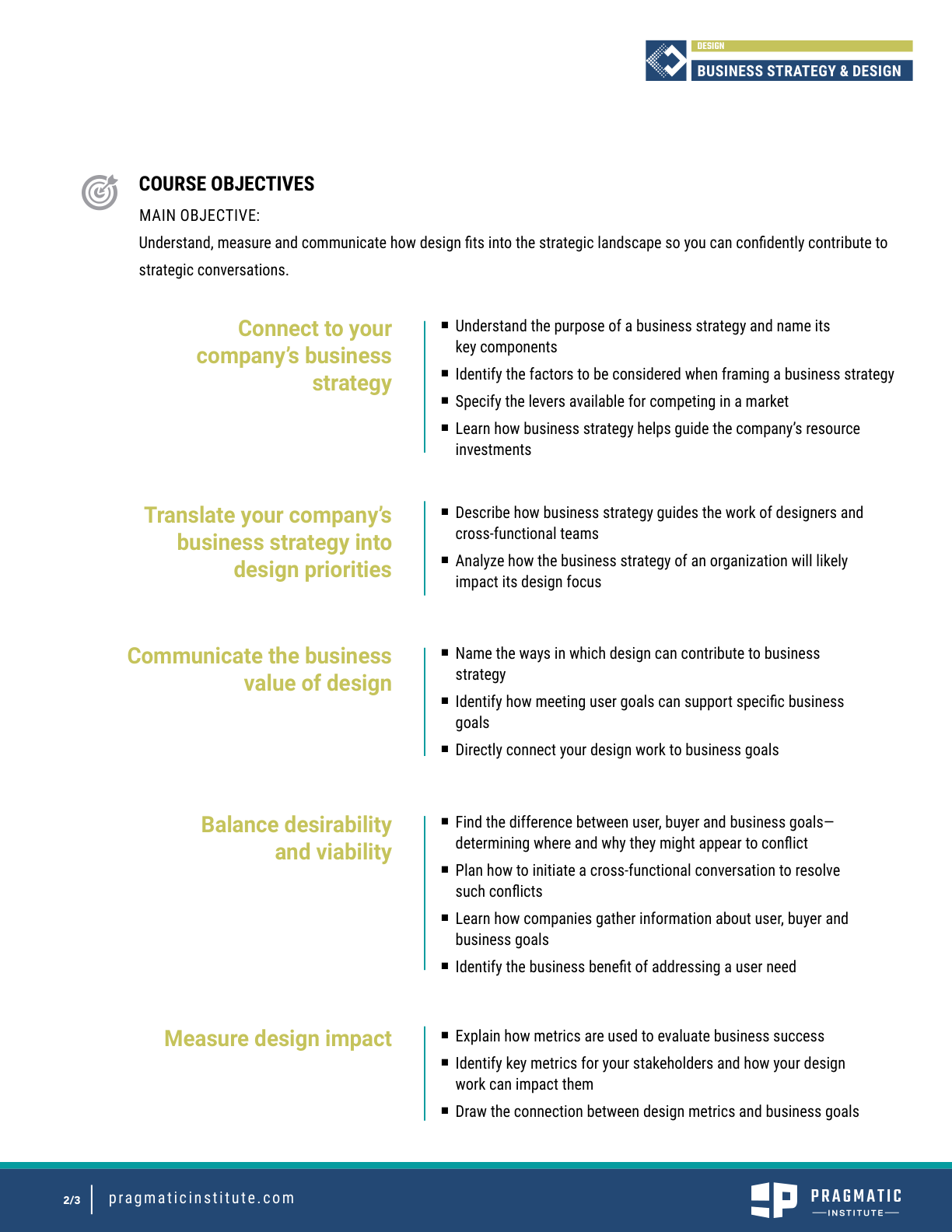
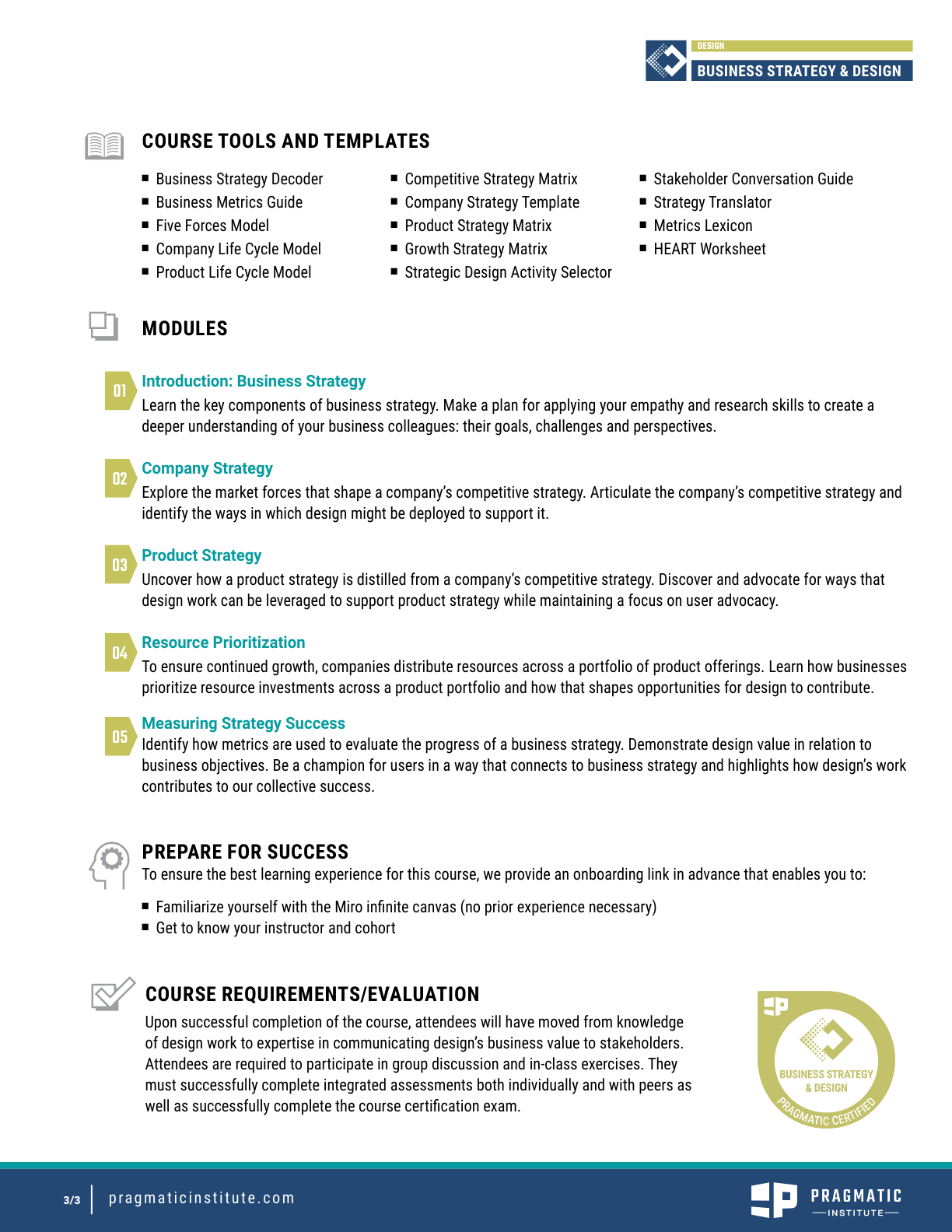
I designed BSD's objectives around the question "what would a CFO ask of this work?" and worked backward. Every module's objective had to do three things: state a behavior (not a feeling), tie to a business lever the company already measures, and ship with an instrument that could prove the behavior happened.
The syllabus anchors every objective to a specific Pragmatic framework — Business Strategy Decoder, Five Forces, Product Life Cycle — so designers could defend the objective by pointing to the same model their business counterparts used. I built matching assessment instruments and moderator call sheets so the objectives flowed cleanly from intent to measurement.
What changed
Designers left BSD able to walk into a budget review with objectives that already spoke the business's language. The course was a top-three revenue contributor in Pragmatic's portfolio.
Learning that lives in the workflow, not the LMS
The context
The Insight course taught product teams to identify and validate the right problems before building. It was rigorous, well-rated, and largely forgotten six weeks later. The problem wasn't the course — it was that problem validation happens at decision points scattered weeks apart, and the workshop's content couldn't reach a learner sitting in front of a customer interview at 2pm on a Tuesday.
The work
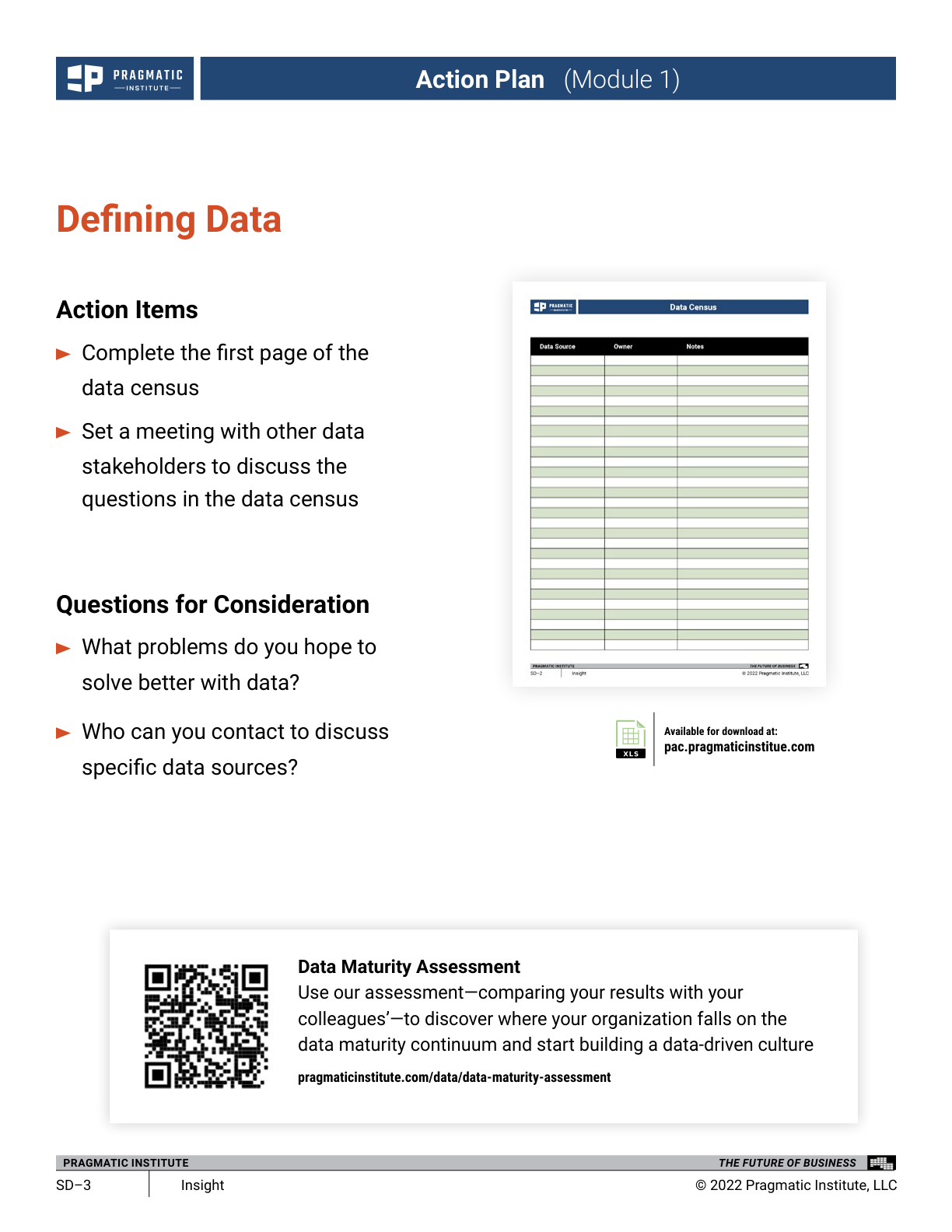
I designed a 67-page supplemental workbook around a different principle than most L&D: the supplement is the course. Every framework — opportunity sizing, customer evidence, problem validation — got a one-page job aid a learner could pull up on a phone during a meeting.
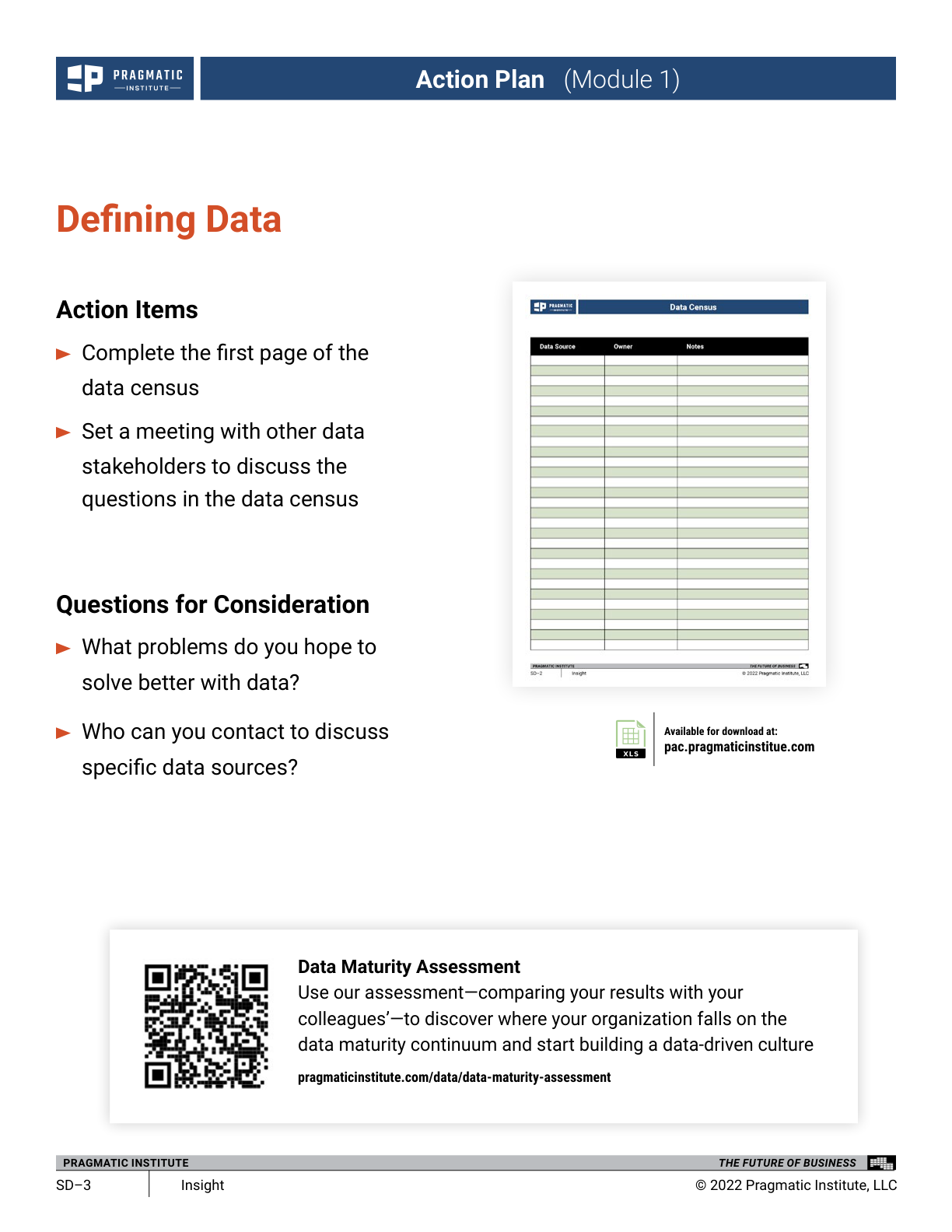
Each module closed with a "data action plan" that paired a learning concept with the specific artifact the learner would produce that week. The workbook referenced itself: a learner who finished Module 1 had a working artifact before they ever opened Module 2, so the learning landed as doing, not as consuming.
What changed
Completion-to-application was high enough that Pragmatic reused this structure as a template for newer courses, and product teams reported that the workbook stayed on their desk six months after the live session.
Give executives a shared vocabulary before giving them answers
The context
Business leaders were approving data initiatives without being able to evaluate them. They got pitched by data scientists in vocabulary they couldn't parse, asked shallow questions, and approved projects they couldn't manage. The result was a portfolio of expensive, misaligned investments.
The work
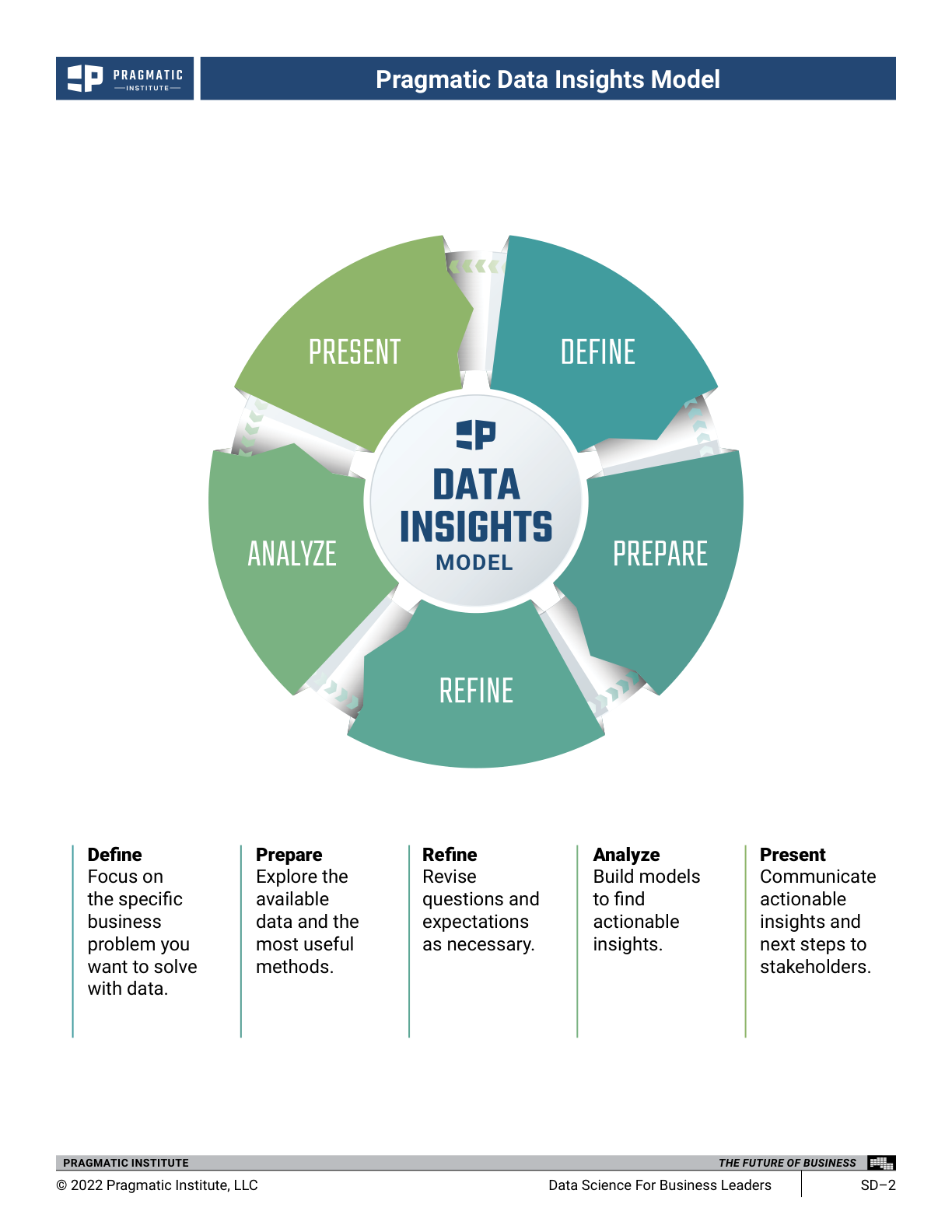
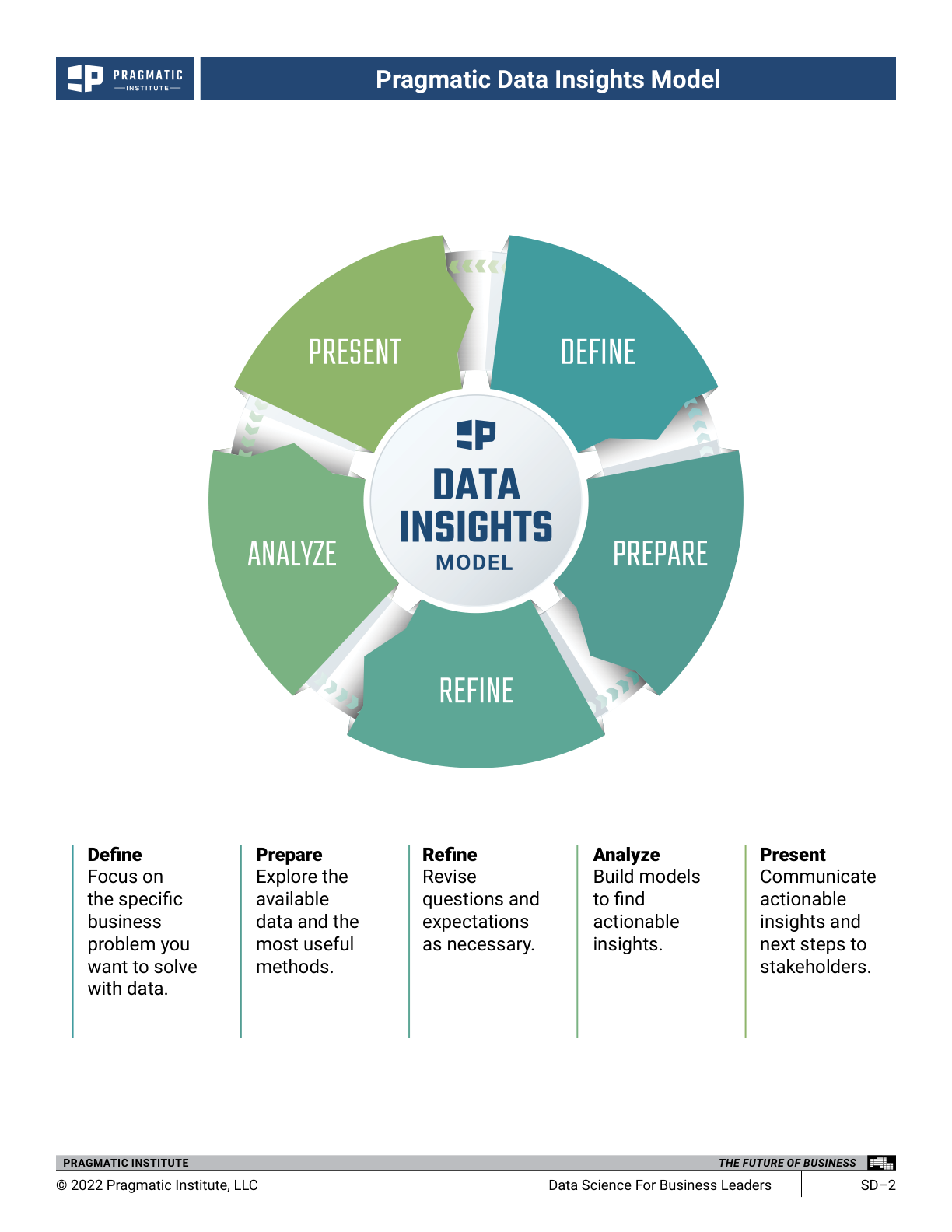
I designed the Data Insights Model — a five-stage framework (Define, Prepare, Refine, Analyze, Present) — as the spine of the course. Every executive lesson anchored to one of the five stages, with the same vocabulary used in their data team's work.
The framework wasn't about teaching statistics; it was about giving the executive a shared mental model so they could ask the right question at the right stage. The 48-page supplemental workbook doubled as a meeting tool — leaders would bring it into steering meetings to map where their initiative was in the model, then use the common vocabulary to redirect.
What changed
The model became the way Pragmatic taught data leadership to executives, and the workbook stayed in active use as a steering tool long after the live course ended.
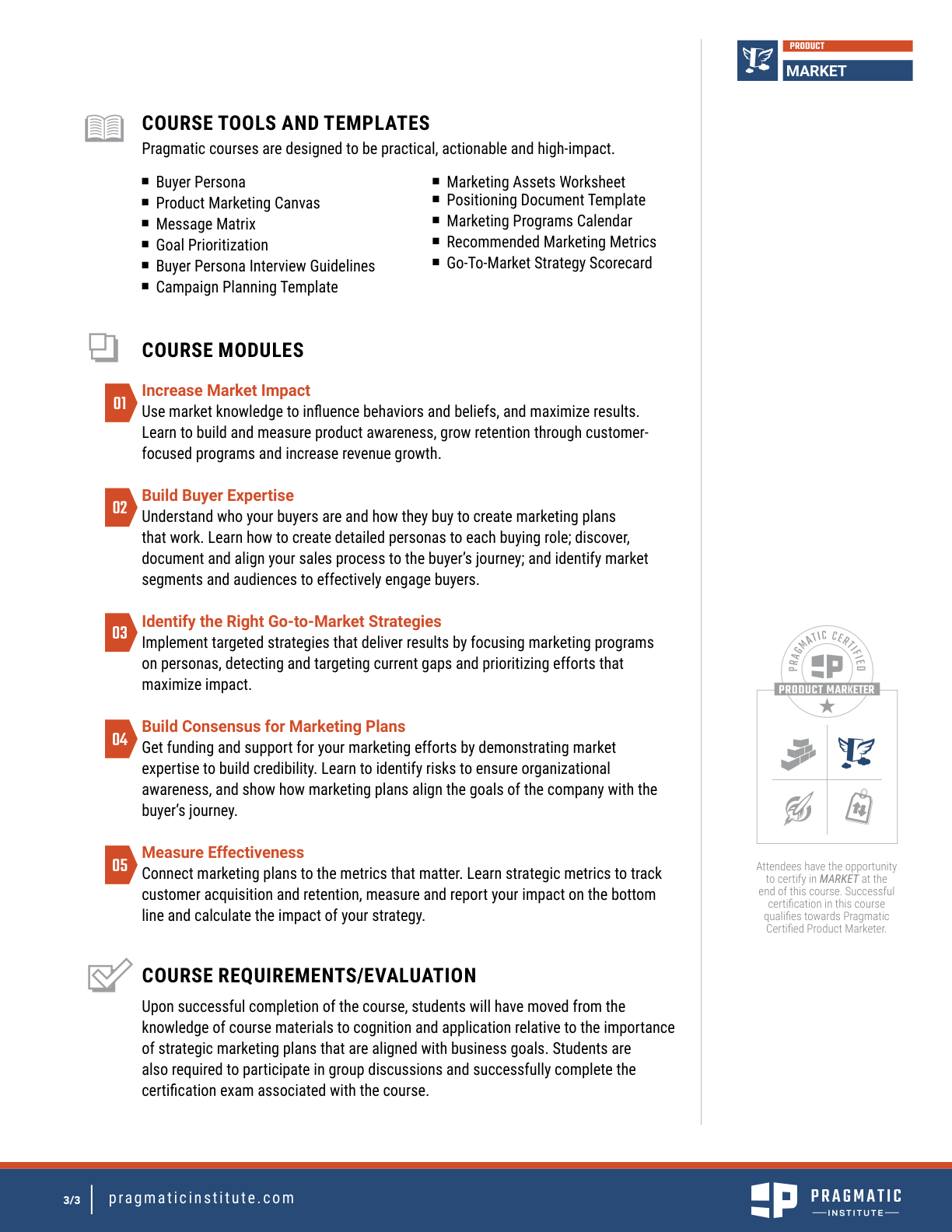
Turning course content into a sales tool that earns its place in the deal cycle
The context
Pragmatic's sales team needed a way to start conversations with L&D buyers who were skeptical of external training. The Market course taught product marketers, but its real strategic value was the artifacts: buyer personas, a Product Marketing Canvas, a Message Matrix. Sales saw these tools as a wedge — give a prospect the buyer persona template, the conversation shifts from "should we buy training" to "how do we run this in our org."
The work
I built the syllabus so the five core artifacts (Buyer Persona, Product Marketing Canvas, Message Matrix, Goal Prioritization, Buyer Persona Interview Guide) were each designed to stand alone. Each got a one-page summary that distilled the framework to its essential decision prompt — designed to be printed, shared, and used in a prospect's first meeting.
The summary pages were the same artifacts sales would later hand a champion to drive internal alignment. I worked directly with sales leadership to validate that the artifacts led to conversations, not just downloads — and tuned the wording on the canvas until a buyer could complete the first section in 15 minutes with their team.
What changed
Sales adopted the artifacts as standard prospect-stage collateral, and the course itself converted at a high rate because buyers arrived already familiar with the framework from the artifact they'd been handed weeks earlier.
Visual work samples
Visual snippets from across the course and storyboard work above. Originals available on request — message me via the contact form.
Note on confidentiality. Most recent work is under NDA. Detailed artifacts — design briefs, storyboards, evaluation reports, roadmaps, launch plans — are available on request during the interview process. Reach out via the contact form.